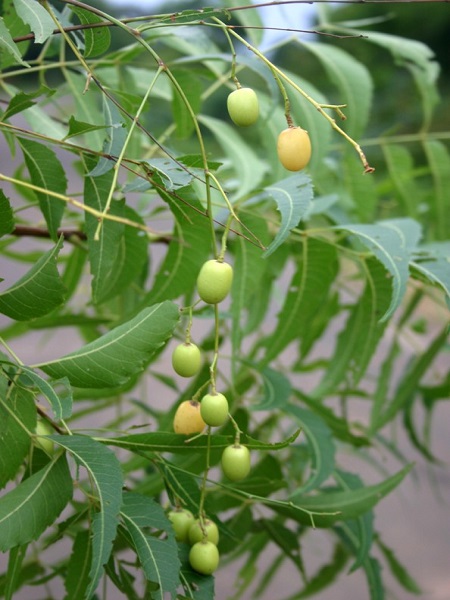
| Family |
Meliaceae |
| English Name |
Neem tree |
| Malayalam Name |
Ariyaveppu, veppu |
| Tamil Name |
Acutakimaram, akaluti |
| Kannada Name |
Bevinamara, kahibevu |
| Telugu Name |
Nimbamu, taruka |
| Hindi Name |
Limbada, neem |
| Sanskrit Name |
Arishta, nimbah |
| Trade Name |
Neem tree |
| Part Used |
All parts of Neem plant |
| In Wild |
Yes |
| Under Cultivation |
Yes |
| Temperature |
40- 50 degree Celsius |
| Rainfall |
400 - 1200 mm |
| Farmers |
NA |
| Traders |
NA |
| Institution |
NA |
| Individually |
NA |
| State/Region |
NA |
| District |
NA |
| Nursery Information |
NA |
| Yield |
NA |
| Economic of cultivation |
Estimated cost of cultivation is about Rs 20,700 per hectare. Per kg of neem seed costs in the market is about 40-50 rupees/kg. |
| Quantitative quality standards |
Foreign matter: not more than 0.3% Ash: not more than 3.0% Acid insoluble ash: not more than 0.25% Ethanol soluble extraction: not less than 4.5% Water soluble extraction: not less than 5.0% |
| Description |
NA |
| Agro technology/Cultivation practices |
Planting-stock production:
Propagules could be raised from seeds and stumps.
Seed propagation: Propagation using seeds is the popular method of growing neem trees. Seeds are collected from June to August. Fresh and ripe seeds should be collected from tree above 5 years old. Seeds remain viable for a short period of 2 to 3 weeks only, therefore should be sown immediately. Nursery is raised in beds of 90cm breadth and seeds should be planted 3 cm apart within a row, and depth of 2.5 cm and maintain irrigation. After about 3 months, seedlings are transplanted. The transplanted seedlings can be raised in polythene bags.
Vegetative propagation– by stumps.
Root and shoot cuttings can be made from 12-13 month old nursery plants. Experiments in Tamilnadu have shown that stumps from 2 year old plants gives higher survival and better height growth than stumps from 1 year old plant. The stumps are prepared with about 2-5 cm shoot and 2-5 cm of root and planted as soon as the rain break.
Field planting: In dry localities pits of 45 cm3 and in moist locality pits of 30 cm3 are dug and kept reat planting. Seedling of 6 -12 month old are out planted into the above pits during the rainy se; Pits can be filled with native soil along with 5 kg FYM and 25 to 50 g of DAP at planting for establishment and growth.
Manuring/Fertilization: VAM Fertilizer application of 50 g, 20 g of Azhospirillum and Phospobacteria to be applied on regular basis.
Irrigation: Neem requires hardly any irrigation. However during the establishment irrigation steps may be required.
Pests and disease: Tip borer (Laspeyresia koenigiana), Tea mosquito bug (Heliopeltis antonii) affect seedlings and young plants. Pulvinaris maxima is a scale insect now regarded as key pest & Heliothripshae morrhoidalis a potential pest of neem. Neem seedlings get severely affected by damping off Rhizoctonia leaf web blight, leaf spot & blights induced by Colletotrichum, Alternaria & Pseudocercospora.
|
| Harversting |
After planting 5th year onwards harvest can be done. To sustain seed viability of home-grown seeds, the pulp of the freshly fallen fruit should be removed from around the seed and the seeds allowed to air-dry in the shade. |
| Processing |
NA |
| References |
NA |